Step 1: You Provide a Drawing or DXF File
The process starts with a 2D drawing of the part you need. The ideal format is a DXF file (AutoCAD or compatible CAD software), which our CNC operator imports directly into the machine's control software. We also accept DWG files and PDF drawings with clear dimensions for simple profiles.
If you don't have a DXF file, a clear hand sketch with all critical dimensions works for rectangular plates, circles, and simple shapes — our operator programs these manually.
Step 2: Nesting and Program Setup
Before cutting, the operator "nests" your profiles onto a standard plate size to minimise material waste — especially important when you're ordering from our stock rather than supplying your own plate. The nesting software arranges parts efficiently and generates the cutting path (G-code) for the CNC controller.
Step 3: CNC Plasma Cutting
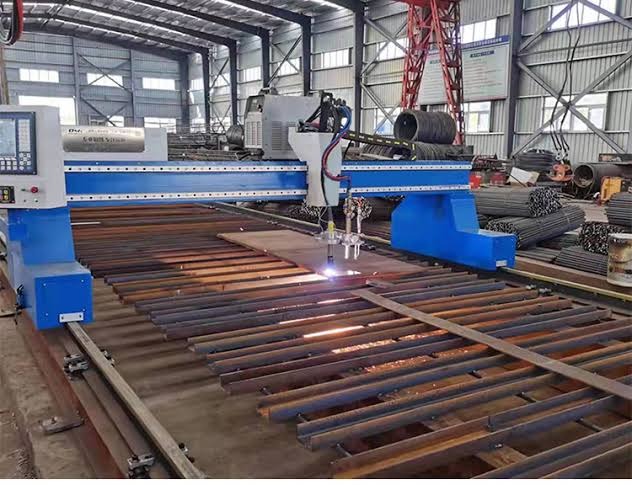
The plate is loaded onto the cutting table. Our large-format gantry CNC machine runs the plasma torch along the programmed path at controlled speed — cutting through the steel with a high-energy plasma arc. The torch position is controlled to ±0.1mm by the machine, though the actual part tolerance is typically ±1–2mm due to the kerf width (the material removed by the plasma arc) and thermal effects.
Step 4: Part Removal and Inspection
After cutting, parts are removed from the table and the cut edges are inspected. Plasma-cut edges have a slight bevel (angularity) — typically 1–3° for standard plasma. For our high-definition plasma setup, edge angularity is reduced significantly.
Key Specifications at Dee Kay Traders
| Max Plate Thickness | 150 mm (MS) |
|---|---|
| Positional Tolerance | ±1–2 mm (thickness-dependent) |
| Edge Finish | Smooth plasma-cut; light slag on lower face (thicker plate) |
| Table Size | Up to 3m × 12m |
| Input Format | DXF, DWG, or dimensioned PDF |
| Material | MS plates (from our stock or customer-supplied) |
What Affects the Price?
Plate thickness — thicker plate requires slower cutting speed and more gas consumption, increasing cost per metre of cut.
Profile complexity — more pierce points (holes, internal cutouts) increase cutting time and consumable wear.
Quantity — larger batches allow better plate utilisation (less waste), reducing cost per piece.
Material source — if you supply your own plate, cutting-only pricing applies. If we supply from stock, material + cutting is quoted together.
Ready to Get Your Parts Cut?
Send us your DXF file, plate thickness, material grade, and quantity. We'll quote within 24 hours.